Building a Scalable Business Operating System for Growing Teams
We engineered a centralized system that replaces chaos with structure, giving teams the clarity they need to scale.
The Problem
Most growing teams operate in a state of "organized chaos." SOPs are scattered across Google Docs, Slack, and emails. Roles are loosely defined, and accountability is difficult to track.
For FlowbookOS, the pain was real: as businesses scaled, the owner became the bottleneck because knowledge wasn't centralized, and ownership wasn't clear. They needed a system that could handle the complexity of organizational structure while remaining simple enough for daily team use.
The Objective
We set out to build a platform that could serve as the operational backbone for any service business.
Centralized Ops
A single source of truth for all company procedures and roles.
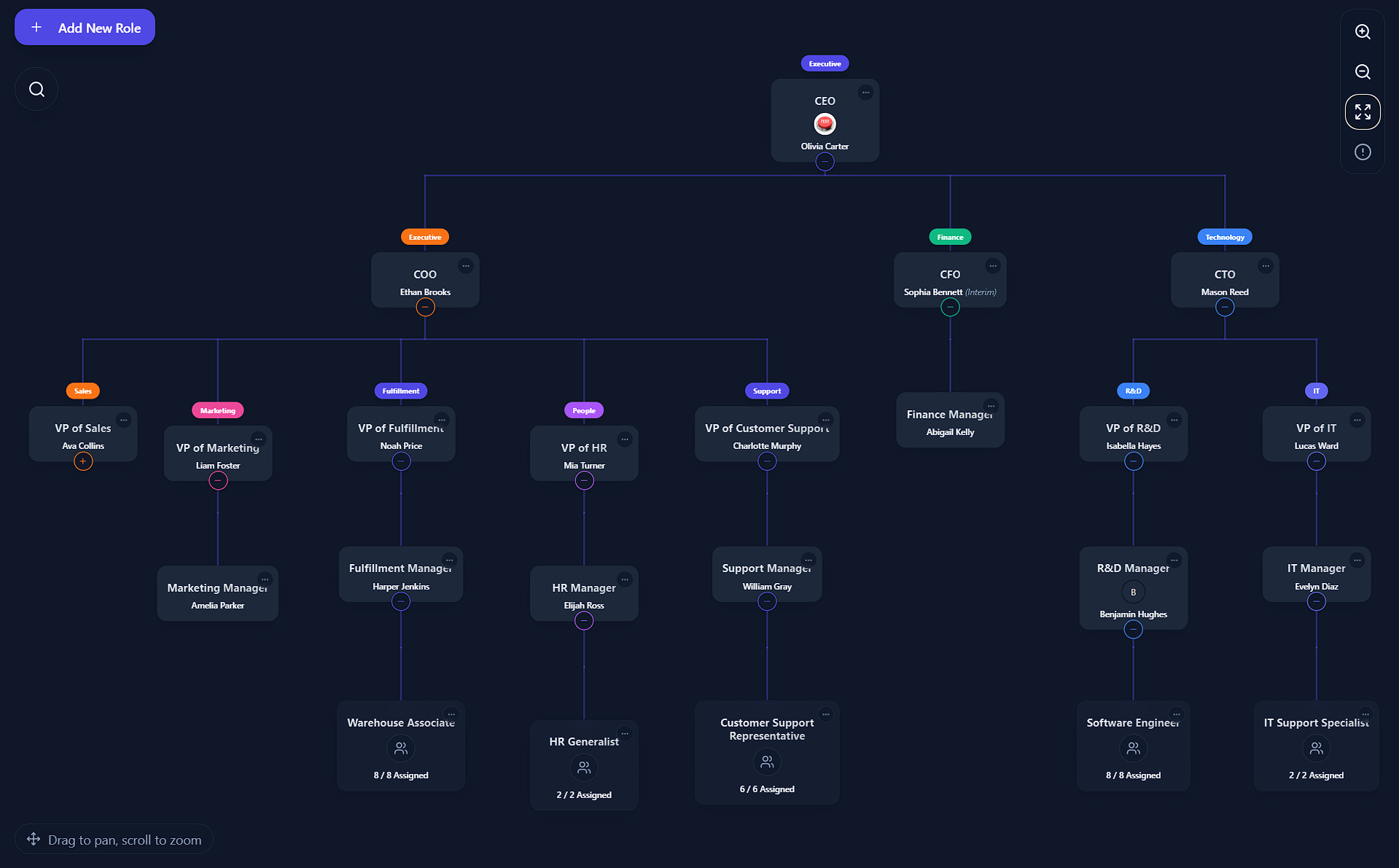
Clear Hierarchy
Visual mapping of responsibilities and reporting lines.
Multi-Tenant
A scalable architecture to support thousands of independent companies.
Simple UI
Hiding complex logic behind an intuitive, modern interface.
System Architecture
Building a business operating system requires a foundation that is secure, scalable, and highly structured.
Multi-Tenant Engine
Each company operates in a strictly isolated environment, ensuring data security while sharing a common infrastructure for updates and scalability.
Role-Based Access
A granular permissions system that maps directly to the organizational chart, ensuring the right people see the right information.
Data Organization
A structured backend designed for high-speed retrieval of SOPs, team metrics, and organizational data as the platform grows.
Core Features & Outcomes
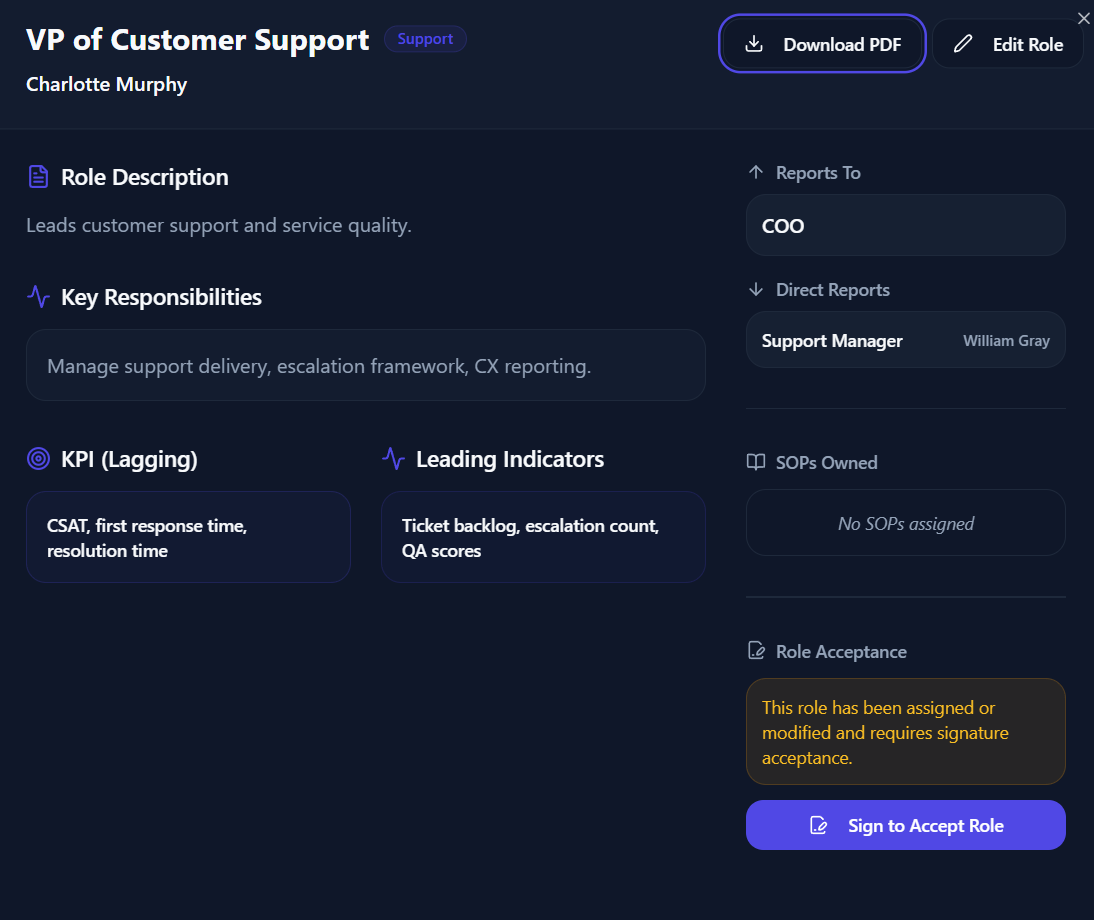
Organizational Structure
Gives teams total clarity on roles and responsibilities. No more "who do I talk to about this?"
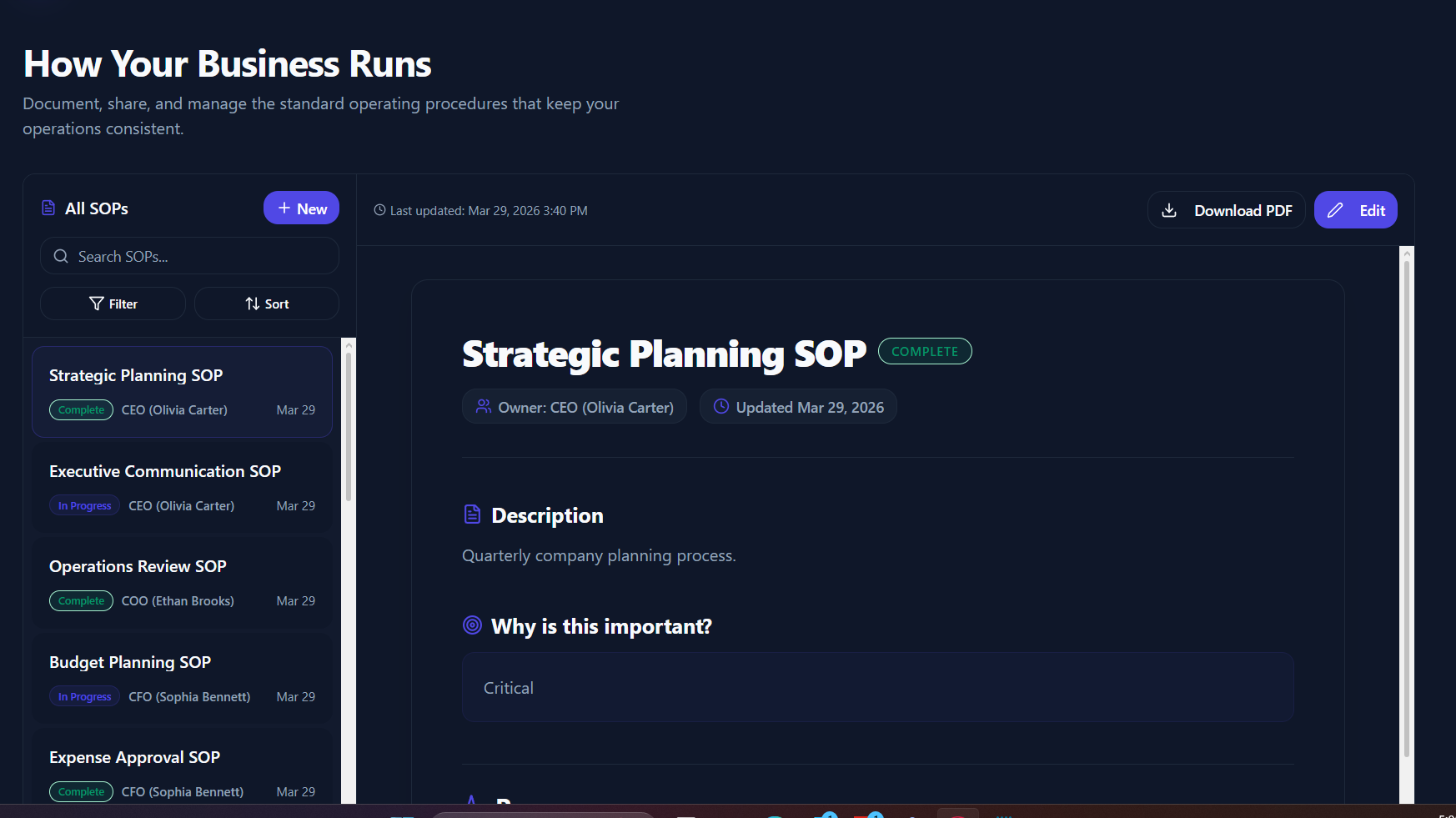
SOP System
Standardizes how work gets done across the company, ensuring consistent results without owner intervention.
Permissions System
Ensures the right people control the right things, protecting sensitive data while enabling team autonomy.
Centralized Knowledge
Eliminates tool sprawl and confusion by bringing everything into one unified operational dashboard.
SOP Manager
Individual Role Cards
UX & Product Thinking
Our biggest challenge wasn't the code—it was the adoption. If a business operating system is too complex, teams won't use it.
We spent significant time hiding complexity from the end user. We designed a clean, intuitive interface that makes managing a 50-person team feel as simple as managing a task list. We built for adoption, ensuring the platform feels like a help, not a chore.
Development Approach
How we took a complex operational vision and turned it into a high-performance reality.
Iterative Development
We didn't build in a vacuum. We deployed early versions to gather real-world feedback, allowing us to refine the core logic based on actual user behavior.
Scalable Foundation First
Before building the UI, we perfected the multi-tenant architecture and data schema, ensuring the platform could handle thousands of companies without lag.
The Result
Operational Clarity
The platform successfully replaced multiple disconnected tools, providing a single source of truth for all company operations.
- Reduced onboarding time by 50%
- Eliminated "who owns this" confusion
- Scalable foundation for future growth
Product Expansion
Built on a solid architectural foundation, FlowbookOS is now ready to expand into automated workflows and deeper integrations.
"Crucible Forged didn't just build an app. They built the system our business actually needed to survive scale."
Key Takeaways
Structure Over Tools: Most businesses don't need more software tools; they need a better operational structure.
Usability is King: Internal software must be as easy to use as consumer apps, or teams will simply ignore it.
Scale Requires Systems: A well-built system reduces the business's dependency on the owner, allowing for true growth.
Looking for the marketing side?
We also built the FlowbookOS marketing website to drive demos and clarify their positioning.
View Website Case StudyIf your business runs on scattered tools and constant interruptions, it's not a people problem. It's a systems problem.
We build custom business systems that replace chaos with structure.